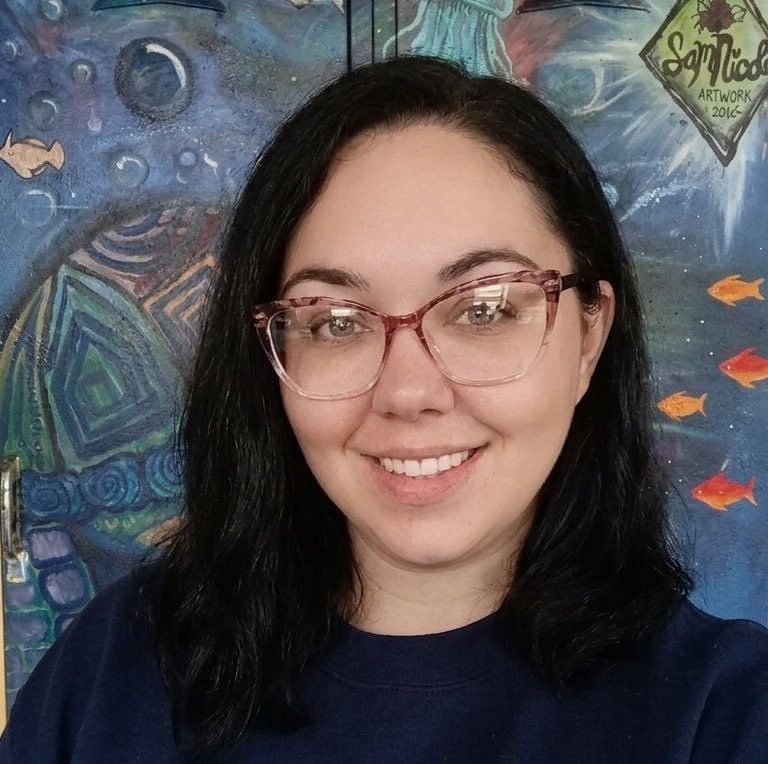
I brought back the interview format on my show after taking a three year break, and I couldn’t have picked a better guest to kick it back off. Samantha Roberts is the founder and designer behind Sam Nicole Designs, a creative studio she started in 2019 out of a love for art. She taught herself graphic design, started taking clients in 2022, and has built her business around a simple mission: helping small businesses look like they belong online.
We came together for this conversation because of something we both share a disdain for. AI slop.
What Is AI Slop, Really?
Mustafaa: When you hear a term like AI slop, what comes to mind to you as a graphic designer, someone who is passionate, has really put in the leg work to do this seriously?
Samantha: Well, unfortunately, the first thing that comes to mind is I first heard the term several years ago in the art community. A lot of artists, not just graphic artists or digital artists, but a lot of artists out there are really upset with it. They are terrified that it’s going to basically make them obsolete. I myself have a completely different opinion, but I heard it lots of years ago, and basically AI slop means that AI is not as good as a human. The flyers and graphics that AI produces almost always have something wrong with them. Most people have seen this. Customers are seeing this. Businesses are seeing this. Everybody is seeing it. And that is where the term AI slop comes into play, because it’s slop. It’s not great. Sometimes the people have five fingers, or there’s so much on one page that it’s really hard to read.
Mustafaa: That’s interesting that you said that. I saw a Facebook group about an hour ago as I was scrolling, and it was a business that had a Facebook group, and they were basically saying, if you use any type of AI flyers or any type of AI generated art, you cannot post in this group, or we won’t work with you.
Samantha: Yeah, you’ll be restricted. And that’s the exact backlash that I’ve been seeing online. I work with different people and help manage their social media as part of my business, and so I get to see a lot of the behind-the-scenes things that you don’t normally see just doom-scrolling down Facebook or TikTok. And it’s not pretty. Half the world thinks that AI is this really cool thing that’s not that important, and then the other half, I think, are like a lot of us designers, and we’re terrified that it’s going to take over our industry.
The Fear Is Real, But So Is the Opportunity
Mustafaa: I was joking with some of my designer friends and I was telling them that I think in the next six months, or before this year ends, you guys are going to be flooded with so much business, as the pendulum swung so far to the left last year, when people found out that AI could do these graphic designs and they could cut out the graphic designer that they may have been paying for. People went gung-ho into it, like, “Oh, let me do my flyers, oh let me do this, let me do that.” And we’re seeing what’s happening with that. So I believe that the pendulum is going to swing back to the opposite side, where people are starting to see, like, I can’t do it on my own, there’s a little bit more to creating flyers than just putting in a prompt.
Samantha: And I agree with that, and I’ve actually already started to see some of that happen, just kind of trickling in. Me personally, I’ve gotten quite a few things. Recently I actually redid a logo for this young lady who has a really adorable little business. She does a lot of handcrafted stuff, and she had built her logo using ChatGPT, but she couldn’t get the letters in the center of it just right. Here comes me, a designer, I fixed it for her pretty quickly, and she was super happy. And I feel like designers are going to be seeing that kind of work flooding in a lot. We’re going to be the fixers. “Oh hey, I made this flyer on AI, can you fix it, I can’t figure out how to fix it.” And I believe that’s what’s going to happen. So as a designer, my advice would be learn AI as fast as you possibly can. Learn how to prompt it, learn how it works, because not only can it make your job faster, more efficient, but you’re going to end up getting these little fixer-upper projects eventually.
It’s Not AI’s Fault, It’s a Skill Gap
Mustafaa: Do you think the issue is AI itself, or is it more about people without design principles, strategy, or creative direction using this AI?
Samantha: I don’t think it’s AI itself, because AI only can do what you tell it to do. I’ve seen a few of your posts here recently talking about prompting AI the right way, and that’s 100% correct. It’s one of the things that they’ve taught us in college, because they taught us basically that the more detail you give it, the better, and so you’re going to get better results. So if you just sit there and you go on ChatGPT and you’re like, “Hey, I want a picture of a unicorn with a purple jacket on,” it’s going to give you a picture of a unicorn with a purple jacket, but it’s going to look awful. But if you took that description and you made it a whole lot more detailed, it’s going to do better. So either which way, you can’t be lazy if you’re going to use AI. It can be great as a creative tool, a scheduling tool, for finding out information, but always fact-check your AI, please, or else you’re going to end up like these guys posting these horrible flyers all over Facebook. If you don’t check what the results are that AI is giving you, you’re going to end up getting burned.
The Method That Actually Works
Mustafaa: What I’ve been doing is AI-assisted graphic design, where I design something and then I ask AI to critique it from the persona of a graphic designer, and ask it to guide me, like what should be here or what should be there, or what would make this look better, kind of get that second set of eyes on it, and then I go back in and design it. I’m getting more back into me putting my hands back on the wheel and kind of using AI as just like an assist. What do you think about that?
Samantha: Yeah, use it like an assistant, because I watched a video on YouTube not long ago, the guy said AI can be great, but you have to talk to it like it’s a five-year-old. And that’s exactly right, because it doesn’t know anything unless you tell it. If you want AI to do something specifically, you need to give it specific directions. And that’s where I think the difference between the people that advance over the next several years and the people that don’t, that’s the difference. Even designers, it’s funny that you mentioned the thing about how you were using it to critique your designs. A lot of designers nowadays are doing 80% AI and the last 20% we’re just going in there and fixing all the little things so it doesn’t look like this crazy AI slop.
What This Means If You’re Studying Design Right Now
Mustafaa: If there’s a student right now that had a passion for graphic design, and maybe they’re hearing these chatters that graphic design may not matter in the future, AI is going to take your job from you, what advice would you give to that student who’s contemplating right now, saying, “I want to sign up for graphic design in college next semester, but I don’t know if this is even going to be a viable career long term to take care of me”?
Samantha: Well, I believe that whether you go to college or you learn online like I did, I believe that graphic design is still definitely going to have a strong need in the future. Like I said, it’s going to be different. I would suggest maybe alongside your graphic design courses, you take some AI courses, you learn as much about technology as you can, because you’re going to need to know all of these things. I for some reason did not think that graphic design was so technologically focused, but it is essentially a tech job anymore. And so if you’re not good with technology, you’re not going to be good with graphic design. Just because you can draw a pretty picture doesn’t mean you know how to vectorize or render a picture. So if it’s something that somebody really wants to get into, I would suggest not only doing the graphic design courses, but taking AI and taking a technology course as well.
Her Message to Business Owners Using AI Flyers
Mustafaa: Is there any message you would like to say to those AI flyer creators out there?
Samantha: Well, that was unexpected, but as for the AI flyer people, please, please, please, either learn how to prompt correctly or hire a designer. A lot of people used to complain about templates and how things all look the same when Canva first came out, and now they’re complaining about the same thing with AI. If you want your business to succeed, either learn how to prompt correctly or hire a designer. Either which way, you’re going to have to pay something. Your money to learn, or your money for a graphic designer. Your choice.
Where to Find Samantha
You can find Samantha Roberts and see her work at Sam Nicole Designs on Facebook and Instagram. She works with small businesses on graphics, custom artwork, small static websites, and social media management, and she keeps her pricing transparent and accessible specifically because she wants to support small business owners.
This post is based on a conversation from my show, Digital Marketing With Mustafaa. Catch new interviews most Wednesdays at 5:30. You can find my podcast, YouTube channel, blog, and everything else at digitalmarketingwithmustafaa.com
Thanks for reading. I appreciate you investing your time here.
If this article gave you something useful, consider supporting my work by buying me a coffee. Every contribution helps me continue creating free content that helps people better understand digital marketing, AI, personal branding, and the digital world.
You can also join the conversation on my Facebook business page, where I regularly share practical tips, answer questions, and discuss what’s happening in the digital space. If you want to go deeper, subscribe to my YouTube channel for longer lessons, tutorials, and real-world strategies you can put into action.
Thank you for being part of the journey.
Support my work: Buy Me a Coffee
Join the conversation: Digital Marketing With Mustafaa on Facebook
Watch and learn: Digital Marketing With Mustafaa on YouTube


Leave a Reply